
Today’s prompt is kind of a tricky one to write. It says to write a piece about a typically “local” experience from where you come from as though it’s an entry in a travel guide. I am stumped because I have no clue what “local” experience means. I’ve never experienced it.

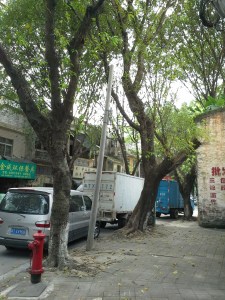
I spent 10 consecutive years of my life in a small corner of southeast China in a town located in the广东(GuangDong) Province called 石岐(Shi’Qi), means stone fort. It’s call that because all the horrible weather seem to avoid this area. It’s California but without the beach and the clear blue skies.
Of all the people I’ve talked to, most of them have no idea where I am talking about. Apparently Google doesn’t either because if you look on the map, it’s not there. So usually, I just end up telling them I’m 90 minutes from Hong Kong. During those years in China, I hardly traveled anywhere. That’s the reason why I don’t even know my local culture because I was always stuck at home doing homework or going to school.
The only time I’ve traveled was during the summer when it’s hot and humid not to mention no AC. One of the reasons for my travel was to visit my extended family, none of them even bothered telling me their names. The place was 大南 (Da’Nan) which I have no idea where it’s located even to-date. When I last visited in the early 2000, it was incredibly rural and undeveloped. No roads. The only way to get around was either on the back of my relative’s truck (bumpy ride) or walk (not a great terrain to walk on).
My relatives still lived in those houses that looked like it was built a century ago, still so old-fashioned. Wooden furniture and bamboo bed (no mattress). I don’t know how it is now but honestly, I’ll never see myself living in that place.
The other reason was to follow my grandpa to another rural part of the province to monitor the progress of the house he was building, the house that I’d never get to see and that my cousin now inherits completely due to our little argument last year. It was boring and gross. Dirt and dog poop everywhere and the often I went, the more I could not see this house to ever be completed. In my mind, it was five-stories of disaster.
More fun facts about my nick of the woods, our delicacy is roast pigeon (烤乳鸽) and we speak the ShiQi dialect (石岐话) which is a dialect that is on the verge of extinction.
I was told a few years ago, people from the north (mandarin-speaking) started to migrate south (cantonese territory) because of the job market. When my mom visited two years ago, she told me that most people speaks either mandarin or cantonese now, no more dialect, she said. She also said most of the people from the town had immigrated to the U.S. in the recent years and most of them reside in the San Francisco Bay area. That’s probably why, most people had left.
I hope you’ve enjoyed this mini-tour of my incognito ever-changing hometown. I think I will have to go back some time this year or the next whether I want to or not. I have to get my teeth fixed and have to collect my insurance money.
 This is Another Story
Another stop on my next vacation itinerary. Small towns. Gotta love them.
LikeLiked by 1 person
The definition of a small town might be different in China. The population of a small town in China is one million plus as compared to the U.S. where small towns are a few hundreds to a couple thousands top. All the same, I’m glad I’ve enlightened you with this mini-tour. 🙂
LikeLike
A interesting quandary you have. There must of had some beauty to the places that you have been?
LikeLiked by 1 person
The park/amusement park there was always nice with trees and water though I’m not sure if the park exists anymore.
LikeLiked by 1 person
How odd not to tell you their names!
LikeLiked by 1 person
It’s not odd at all because the older generations tend to go only by relationships like great-aunt or great-grandpa.
LikeLiked by 1 person
Ah, I see!
LikeLiked by 1 person
Very interesting mini-tour Yinglan. You’ve presented quite a vivid picture of the area in which grew up. 🙂
LikeLiked by 1 person
Thanks! I think it’s completely changed now though. The town was almost unrecognizable the last time I went back.
LikeLiked by 1 person
It seems to be the same story in so many places. I suppose it’s just ‘progress’. 🙂
LikeLiked by 1 person
I supposed that nothing stays the same forever. Everything’s ever-changing.
LikeLiked by 1 person